· By Salman Habib Chaudhry · AI Marketing · 8 min read
The AI-Powered Lead Generation Playbook (2026)
A practical lead-generation playbook built around AI — how to generate, score, route, and nurture leads with AI in the loop without sacrificing quality or trust.
“AI lead generation” in 2026 still means wildly different things depending on who you ask. To a CRO agency it’s chatbot qualification. To a paid media shop it’s smart bidding. To an outbound SaaS it’s automated sequences at scale. None of those alone is a playbook — it’s a feature.
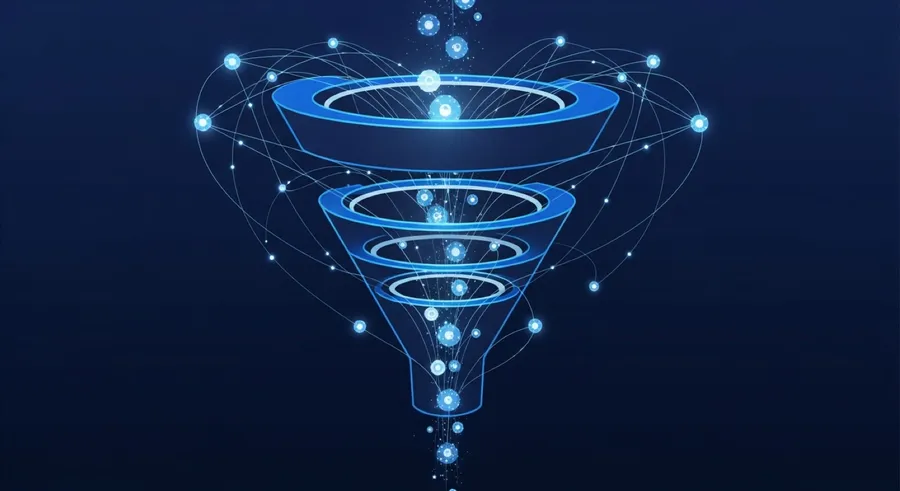
A real AI-powered lead generation playbook runs across the full funnel: generation, qualification, routing, nurture, and close. Here’s the version we actually run for Ontario clients, with the AI layer in each stage honestly described (no “revolutionary” language).
Key Takeaways
- A real AI lead-gen playbook covers the whole funnel — generation, qualification, routing, nurture, and close — not one chatbot or bidding feature in isolation.
- Speed of response is the most under-built piece of most stacks: leads contacted within 5 minutes are roughly 100x more likely to qualify than those contacted within 30.
- AI earns its place at each stage: scoring leads, routing them to the right rep instantly, and keeping slow deals warm — not replacing the salesperson who closes.
- Sales and marketing are where AI adoption has produced the highest reported revenue impact, per McKinsey’s State of AI research.
- “AI lead generation” means different things to different vendors, so judge a stack by whether it improves response speed and qualification, not by buzzwords.
McKinsey’s State of AI report shows sales and marketing are the two functions where AI adoption has produced the highest reported revenue impact. And the classic InsideSales / Lead Response Management study — referenced across HubSpot’s research — found leads contacted within 5 minutes are roughly 100x more likely to qualify than those contacted within 30. Speed of response is the single most under-built piece of most AI lead-gen stacks.
The five stages
- Generation — getting leads into the top of the funnel
- Qualification — separating tire-kickers from real buyers
- Routing — getting the right lead to the right person, fast
- Nurture — keeping slow-moving deals warm
- Close + handoff — converting qualified opportunity into customer
AI plays a role in all five, but the role is different in each. Teams that apply AI everywhere equally end up with a tangled, brittle system. Teams that pick the 2–3 stages where AI has genuine leverage build something maintainable.
Stage 1 — Generation
Where AI actually helps:
Paid media bidding. Google’s Smart Bidding, Meta’s Advantage+, and LinkedIn’s Predictive Audiences all use ML to match ads to high-intent users. This is table stakes in 2026. For setup that makes these algorithms actually work, see Google Ads Conversion Tracking for Service Businesses.
Content at scale. Claude, GPT, and similar models let a 2-person content team produce what used to require 5. Not by replacing the writers — by compressing the research, outlining, and draft phases. Humans still edit, still fact-check, still add proof.
Programmatic pages. Location pages (like DEM’s own /locations/mississauga, /locations/toronto, etc.), comparison pages, and glossary entries can be built from a data source with AI generating the prose. Avoid doorway-page patterns — every page needs genuinely unique content.
Where AI does NOT help (yet):
Cold outreach “personalization.” AI-generated first lines (“I noticed you recently posted about X”) get recognized as AI within months and tank reply rates. Human-generated first lines plus AI-sequenced follow-ups is the working pattern. See B2B Cold Email Deliverability.
Brand trust building. AI can help you write more content, but the trust layer — case studies, testimonials, named author bios, real photos — still requires human effort and real customers.
Stage 2 — Qualification
This is where AI earns its keep most reliably.
What AI does well:
Lead scoring from CRM data. HubSpot’s predictive lead scoring, Salesforce’s Einstein, and similar tools can score a new lead 5–10x more accurately than a rule-based system once they have 500+ scored leads of training data.
Chatbot and form qualification. A well-built AI chat can filter out tire-kickers and book real prospects to a sales calendar, unassisted. Modern implementations (Intercom Fin, Drift, custom GPT-powered widgets) are genuinely better than the 2020-era rule-based bots.
AI voice agents for inbound calls. Perhaps the biggest unlock for service businesses. A missed phone call on a Saturday morning is a missed job. AI voice agents capture, qualify, and schedule 24/7. See AI Voice Agents: The Future of Lead Capture.
Qualification checklist:
- Budget, authority, need, timeline (BANT) signals captured on the first touch.
- Lead-scoring model trained on the most recent 6–12 months of closed-won vs closed-lost data.
- Auto-routing rule: score > X → sales rep immediate; score < X → nurture track.
- Daily review of any lead misclassified by the AI. Feedback loop is what keeps the model honest.
Stage 3 — Routing
Speed of response is the single biggest predictor of close rate. Industry research has consistently shown that leads contacted within 5 minutes are 8x more likely to convert than leads contacted within 30 minutes.
The routing stack:
- Webhook-triggered notifications. A form submission fires a webhook; the assigned rep gets a Slack or SMS notification with the lead details. No waiting for an email to be checked.
- Round-robin + owner-based routing. HubSpot, Close, and Chili Piper all do this well. Round-robin within regions, owner-based when a lead is already in the CRM.
- AI-suggested next action. For the rep opening the lead: “This lead matches your closed-won customer profile, suggested talking points: X, Y, Z.” This is where Gong, Clari, and HubSpot’s Sales Hub AI are legitimately useful.
- Instant booking. Give qualified leads the ability to book directly on a sales calendar (Chili Piper, Calendly, HubSpot Meetings). Speed beats polish.
Stage 4 — Nurture
Most leads won’t buy on first touch. Nurture is where AI shifts from “helpful” to “essential” — a human team can’t personalize 500 nurture sequences, but AI can.
Nurture tactics that work:
- Behavioural email sequences. Klaviyo for e-commerce (see the 8 flows every Shopify brand needs), HubSpot or ActiveCampaign for B2B. Trigger on events, not dates.
- AI-written follow-up drafts. When a sales rep is following up on a lead, an AI-drafted email based on CRM context saves 10–15 minutes per message. Rep still edits; rep still sends. But the blank-page friction is gone.
- Content retargeting. Meta and LinkedIn retargeting to leads who’ve downloaded a lead magnet but haven’t converted. Show them the next-step content (case study, webinar, comparison page).
- Sales-assist AI. Gong and Clari capture every sales call; AI surfaces churn risk and deal stall signals before a human notices them.
What to avoid:
- Generic “check-in” sequences. If the AI has nothing new to say, say nothing. Silence > filler.
- Over-automating. If a high-value lead goes 3 rounds deep in an automated sequence without hearing from a human, close rate collapses. Route VIPs to humans fast.
Stage 5 — Close + handoff
Once a deal closes, the playbook isn’t done — it loops back to stage 1 as post-sale lead-gen for expansion and referrals.
Close-stage AI:
- Proposal generation. Tools like Pandadoc + AI drafting shave hours off custom proposals.
- Contract review. AI-assisted redlining for service agreements — paralegal-level checks in seconds.
- Post-sale onboarding sequences. Trigger the right onboarding content based on the customer’s use case, usually inferred from their sales conversations.
- Expansion-cue detection. AI monitors product usage (for SaaS) or service cadence (for agencies) and flags expansion opportunities.
The honest scorecard
Not every AI lead-gen tactic is worth shipping. Here’s our current read on what’s earning its keep vs what’s hype:
| Tactic | Verdict |
|---|---|
| Smart Bidding / Performance Max | ✅ Essential |
| AI voice agents for inbound calls | ✅ Essential for service businesses |
| AI-powered lead scoring | ✅ Essential above ~100 leads/month |
| Chatbot qualification on high-traffic sites | ✅ Strong |
| AI-drafted sales follow-ups | ✅ Strong |
| AI-written cold email openers | ❌ Detectable, hurts more than helps |
| AI-generated long-form content without human edit | ❌ Obvious slop; ranks poorly |
| ”Fully autonomous” AI sales rep products | ❌ Not ready for most B2B in 2026 |
Sequencing advice
If you’re building this for the first time, in order of ROI:
- Conversion tracking (prereq for everything).
- Speed-of-response stack (routing + instant booking).
- Lead scoring based on CRM history.
- AI voice/chat for lead capture when humans aren’t available.
- Behavioural email nurture.
- AI-assisted sales workflow (follow-up drafts, deal insights).
Most SMBs we work with get 80% of the value from items 1–4. Items 5 and 6 are the long tail.
Where this fits
This is a spoke of the AI Growth Systems cluster — see The AI Marketing Stack for Ontario SMBs 2026 for the tool-level buyer’s guide that sits underneath this playbook. The conversion-tracking prerequisite is covered in Google Ads Conversion Tracking for Service Businesses; the AI voice agents piece is covered in AI Voice Agents: The Future of Lead Capture.
If you want us to design and implement this playbook for your business — tracking, routing, AI voice agents, nurture — that’s exactly what our AI SEO and SEO services engagements cover, including AI agent call systems for the 24/7 lead-capture layer.
Where this fits
Part of the AI growth cluster: The AI Marketing Stack for Ontario SMBs, AI Voice Agents: The Future of Lead Capture, How AI Automation Is Transforming Small Business Operations, How AI Is Transforming Digital Marketing in 2025, and LLMO Explained: Large Language Model Optimization.
Sources
- McKinsey — The State of AI in Early 2024 — 2024
- HubSpot — Sales statistics and benchmarks — accessed 2026-05-22
- Lead Response Management Study (InsideSales) — industry study referenced across major CRMs
- Salesforce — State of Sales Report — accessed 2026-05-22
- Anthropic — Claude product documentation — accessed 2026-05-22