· By Salman Habib Chaudhry · Email Marketing · 8 min read
Klaviyo Flows Every Shopify Brand Needs in 2026
Eight Klaviyo flows that drive 30-45% of Shopify revenue, with 2026 send-time, recovery, and revenue-per-recipient benchmarks for each one.
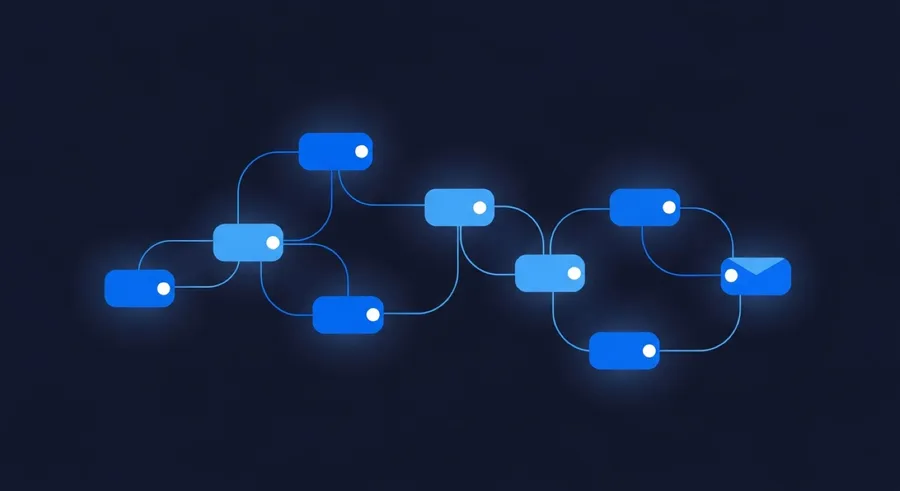
Klaviyo flows account for 30–45% of email revenue in most Shopify stores we work with — whether they’re Mississauga-based brands or ecommerce businesses across the GTA and Canada. Klaviyo’s own 2024 benchmark report puts automated flow revenue at roughly a third of total email-attributed revenue across DTC, and Litmus’s 2024 State of Email shows automated triggers outperform broadcasts on revenue-per-send across every vertical they measured. Most brands ship only two or three of the flows they should have, and the ones they do ship are often set up once and never revisited. Here are the eight flows we build on every Shopify engagement, what each should contain, and the metrics that tell you whether they’re earning their keep.
If you’re still deciding whether to stay on Mailchimp or switch, the companion piece is Klaviyo vs Mailchimp: Which Email Platform Is Right for Your E-commerce Brand?. This post assumes Klaviyo is already your platform.
Key Takeaways
- Automated Klaviyo flows account for 30–45% of email revenue in most Shopify stores — automation outperforms broadcasts on revenue-per-send in every vertical.
- Most brands ship only two or three of the flows they need, and the ones they do ship are set up once and never revisited.
- The eight flows every store needs: welcome, abandoned cart, browse abandonment, post-purchase, replenishment, win-back, VIP, and sunset.
- Each flow has specific content it should contain and metrics that tell you whether it’s earning its keep — set-and-forget leaves money on the table.
- Flows are the highest-ROI email work because they run continuously on shopper behaviour, not on your campaign calendar.
The eight flows
- Welcome series — for new list subscribers
- Abandoned cart — for shoppers who added to cart and left
- Browse abandonment — for shoppers who viewed products and left
- Post-purchase series — thank-you, education, upsell, review request
- Replenishment — for consumables, predictable repurchase windows
- Win-back — lapsed customers
- VIP / high-value customer — repeat buyers, top 20%
- Sunset — disengaged subscribers (deliverability protection)
In revenue-per-send order, abandoned cart and post-purchase usually dominate. In long-run impact order, welcome and win-back matter most. Ship all eight; the weakest still pays for itself.
1. Welcome series
Trigger: new list subscriber (signup form, checkout opt-in, exit intent). Length: 3–5 emails over 7–14 days. Goal: convert the subscriber to a first-time buyer.
Email structure:
- Email 1 (sent immediately): Welcome + discount code (usually 10–15%) + brand story (2 paragraphs, not a novel).
- Email 2 (+2 days): Bestsellers or category explainer. “Here’s what most customers start with.”
- Email 3 (+4 days): Social proof — UGC, reviews, or press mentions. No direct pitch.
- Email 4 (+7 days): Discount reminder if unused. “Your welcome code expires in 48 hours.”
- Email 5 (optional, +10 days): Founder or brand values email. Builds connection for non-buyers.
Benchmarks: 40–60% placed-order conversion rate from welcome flow is healthy. Under 25% means either the discount is off, the audience is wrong, or the product-market fit isn’t there.
2. Abandoned cart
Trigger: cart created but no order within 30 minutes. Length: 3 emails over 72 hours. Goal: recover the sale.
Email structure:
- Email 1 (+30 min to 2 hours): “You left something behind.” Product image, one-click return to cart, zero pitch. Sometimes this is all it takes.
- Email 2 (+24 hours): Overcome objections. Reviews, shipping info, return policy. No discount yet.
- Email 3 (+48–72 hours): Final email with a discount or free shipping. Not before — training your buyers to wait for a discount is a long-run margin killer.
Benchmarks: 10–20% recovery rate on placed orders from abandoned cart flow is healthy for most DTC brands (Shopify’s cart abandonment data pegs the industry-wide average abandon rate near 70%, which is what makes recovery flows the highest-leverage revenue line in any Klaviyo account). Under 5% usually means Email 1 is too aggressive (pushy subject line) or the trigger is misconfigured (firing for bots).
3. Browse abandonment
Trigger: viewed a product page 2+ times without adding to cart. Length: 1–2 emails. Goal: nudge the research-mode shopper back.
Email structure:
- Email 1 (+4 hours): “Still thinking about this?” with the viewed product(s) and 2–3 related items.
- Email 2 (+48 hours, optional): Soft social proof — reviews of the specific product(s) they viewed.
Important: exclude anyone already in the abandoned-cart flow. Overlapping flows is a common mistake that trains subscribers to ignore your emails.
Benchmarks: 3–8% click-through. Revenue-per-send is lower than abandoned cart (the buyer was earlier in the journey) but the flow is nearly free to run.
4. Post-purchase series
Trigger: first order placed. Length: 4–6 emails over 30 days. Goal: repeat purchase + review.
Email structure:
- Email 1 (immediately): Order confirmation in brand voice (not just the Shopify default).
- Email 2 (+3 days): “What to expect” — shipping timeline, usage tips.
- Email 3 (+day of estimated delivery): Care instructions, usage guide, or onboarding content.
- Email 4 (+14 days): Review request. This is the single highest-ROI email in the flow for most brands — UGC and social proof compound for years.
- Email 5 (+21 days): Cross-sell or replenishment trigger (linked to flow #5 below).
- Email 6 (+30 days): “How’s it going?” — open-ended engagement. Drives reviews and soft customer-service moments.
Benchmarks: 12–25% of first-time buyers should make a second purchase within 90 days from post-purchase flow. Brands hitting 30%+ have unlocked repeat-purchase economics and can spend more to acquire.
5. Replenishment
Trigger: specific time after purchase, calibrated to product lifespan (14, 30, 60, 90 days depending on SKU). Length: 1–2 emails. Goal: re-order before the customer runs out.
When to ship: consumables (skincare, supplements, coffee, pet food, candles). Skip for categories with long usage cycles (furniture, apparel without core staples).
Email structure:
- Email 1 (at estimated deplete): “Time to restock?” with one-click reorder link.
- Email 2 (+5 days): Subscription pitch if the brand offers it.
Benchmarks: replenishment flows should drive 8–15% of total email revenue for consumables brands. If yours is under 3%, either the timing is wrong or Klaviyo isn’t connected to Shopify’s line-item data (Klaviyo → Integrations → Shopify → verify Placed Order syncs with SKUs).
6. Win-back
Trigger: no purchase in N days (usually 90–180 depending on category). Length: 2–3 emails. Goal: reactivate lapsed customers.
Email structure:
- Email 1: “We miss you.” Soft, no discount yet. Highlight what’s new since their last purchase.
- Email 2 (+7 days): Discount or incentive to return (usually 15–20%).
- Email 3 (+14 days, optional): “Last chance” before segment moves to sunset.
Benchmarks: 5–12% recovery. Win-back flows are the quietest revenue drivers — not flashy, but compounding.
7. VIP / high-value customer
Trigger: 2+ orders OR lifetime spend above threshold (varies; for most brands $300+ is the cutoff). Length: ongoing, not a one-shot flow — more of a VIP track. Goal: deepen loyalty, reward behaviour.
What to send:
- Early access to product launches (48 hours before public).
- Exclusive bundles or tiers unavailable to general list.
- Handwritten-style “thank you” from the founder at purchase milestones (3rd, 5th, 10th order).
- Direct line to customer service for issues.
VIPs account for 60–75% of repeat revenue in most DTC brands. Treating them as a separate tier — not just another newsletter segment — is usually the single biggest revenue unlock in a Klaviyo account beyond the basics.
8. Sunset
Trigger: no open, click, or purchase in 90+ days. Length: 1 final email. Goal: deliverability protection.
Email structure:
- Email 1: “Still want to hear from us?” with clear re-engagement CTA. If they don’t engage within 7 days, move them to a suppressed segment.
Skipping sunset is the single biggest reason Klaviyo accounts see deliverability tank. Disengaged subscribers hurt your inbox placement for engaged ones — Google’s 2024 bulk-sender rules explicitly call out spam complaint rates and engagement signals as inbox-placement inputs. Cutting them isn’t optional; it’s hygiene.
Measuring whether flows are working
Four metrics to check monthly:
- Revenue per recipient by flow. Abandoned cart should lead; post-purchase second; welcome third.
- Flow revenue as % of total email revenue. Healthy: 30–45%. Under 20% means flows are under-shipped or misconfigured. Over 60% means your campaigns (broadcast emails) are under-invested.
- Placed-order rate per flow. Track trend, not absolute. A 2-percentage-point drop over 8 weeks is a signal to audit.
- Deliverability: inbox placement, spam complaints, unsubscribe rate. Most Klaviyo accounts don’t track these, then wonder why open rates drop.
Common mistakes
- Welcome flow pointing to the wrong landing page. Half the brands we audit send welcome emails to the homepage instead of a dedicated collection page or bestseller list. The homepage is a terrible conversion destination.
- Abandoned cart with discount in Email 1. Trains buyers to abandon on purpose. Discount belongs in Email 3 at earliest.
- Post-purchase review request at +3 days. Too early — they haven’t used the product. +14 days is the sweet spot for most categories.
- No VIP track. Leaves the highest-margin customers in the same bucket as tire-kickers. Revenue left on the table.
Where this fits
This post is a spoke in DEM’s email-marketing cluster. The pillar is Why Email Marketing Still Delivers the Highest ROI; the comparison of platforms is Klaviyo vs Mailchimp; the setup walk-through is How to Set Up Klaviyo for a Mississauga Ecommerce Brand; and for the copy side of these flows, see AI-Generated Email Copy That Doesn’t Look AI-Written. For B2B brands where the email playbook looks different, see Cold Email Outreach in 2026: Complete Guide for B2B Lead Generation. Email is one channel in the wider store-growth mix — see how it fits alongside SEO, Google Shopping, and paid social in our e-commerce marketing overview.
Sources
- Klaviyo Ecommerce Industry Benchmarks — Klaviyo, 2024
- Litmus State of Email 2024 — Litmus, 2024
- Shopping Cart Abandonment: Industry Data and Recovery Tactics — Shopify, 2024
- Email sender guidelines (bulk-sender requirements) — Google, updated 2024
If you want us to build or overhaul these flows for you, that’s exactly what our Klaviyo flows service for Toronto and GTA Shopify brands covers — full account audit, flow buildout, and monthly optimization.