· By Salman Habib Chaudhry · SEO · 11 min read
Technical SEO Agency: How to Pick One That Actually Moves Rankings
Five questions that filter real technical SEO consultants from generalists, plus the 90-day deliverables and Canadian retainer brackets that signal a serious shop.
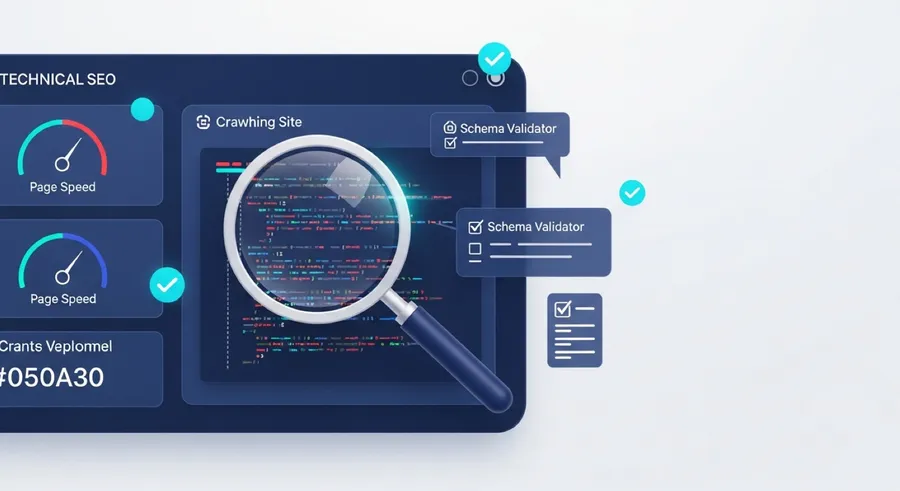
Most agencies that call themselves a technical SEO agency are doing the same thing: running Screaming Frog, sending you a 60-page PDF, and quoting another retainer. You can do better. This guide walks through what technical SEO actually is, what an agency should produce in the first 90 days, and the questions that filter pretenders from operators.
If you are a Canadian business choosing between four or five shortlisted agencies, skip to the questions section. If you are still figuring out whether technical SEO is what you need at all, start at the top.
Key Takeaways
- Many “technical SEO agencies” just run Screaming Frog, hand you a 60-page PDF, and quote a retainer — you can demand more than a report.
- Technical SEO covers what Google’s crawlers, indexers, and ranking systems care about beyond the words: speed, JavaScript rendering, canonicals, orphaned URLs, schema, sitemaps, and crawl budget.
- A good agency produces concrete fixes (not just findings) within the first 90 days.
- The questions you ask in the pitch are the main filter between operators and pretenders.
- If you’re shortlisting agencies, jump to the questions section; if you’re unsure you even need technical SEO, start from the top.
What technical SEO actually solves
Technical SEO covers the parts of your site that Google’s crawlers, indexers, and ranking systems care about that have nothing to do with the words on the page. Site speed, render-blocking JavaScript, broken canonical tags, orphaned URLs, internationalization signals, schema markup, sitemap hygiene, and crawl budget all live here.
The simplest way to think about it: content gets you eligible to rank, on-page SEO tells Google what each page is about, and technical SEO removes the friction that stops Google from finding, rendering, and trusting your pages in the first place. If your site has a content problem, technical SEO will not fix it. But if your content is solid and your rankings are stuck below where they should be, technical issues are usually why.
Common symptoms that point at technical SEO rather than content or links:
- Pages indexed but ranking erratically week to week, jumping 20 or 30 positions
- New pages take three to six weeks to be indexed at all
- Mobile rankings noticeably worse than desktop for the same query
- Search Console showing high “Discovered – currently not indexed” or “Crawled – currently not indexed” counts
- Pages with strong backlinks ranking lower than pages with none
- Drop in organic traffic the same week as a site migration, redesign, or framework change
Any of these in your data means you have a technical layer doing damage. The goal of a good technical SEO agency is to find every issue, prioritize by traffic impact, and ship the fixes through your dev team.
Technical SEO services vs. on-page services vs. off-page services
These three terms get used interchangeably, which makes pricing comparisons hard. Here is the line between them:
Technical SEO services are infrastructure: crawlability, render path, page speed, structured data, hreflang, canonical logic, redirect chains, log file analysis, JavaScript rendering verification, and Core Web Vitals. The deliverables are usually a prioritized issues list, a fix specification for engineers, and validation testing after each fix lands.
On-page SEO services are content-layer: title tags, meta descriptions, heading hierarchy, internal linking patterns, image alt text, content gap analysis, and entity coverage. The deliverables are page-level recommendations and content briefs.
Off-page SEO services are everything that happens outside your site: link earning, digital PR, brand mentions, citation cleanup, and reputation management. The deliverables are placements and link metrics.
A real technical SEO agency does the first one well and is honest about whether they need to bring in content or link partners for the other two. An agency that bundles all three under “technical SEO” is selling you a generalist retainer.
What a 90-day technical engagement should produce
If you sign with a technical SEO agency in May, here is what should be on the table by August.
Days 1 to 14 — full audit. A real audit is not just running a tool. It is a crawl plus log file analysis plus a manual review of how Googlebot actually fetches your site. The output should be a categorized list of issues with three columns: estimated traffic impact, engineering effort, and dependency. You should be able to read it and immediately know what to fix first.
Days 15 to 45 — first wave of fixes shipped. This is where most agencies fall apart. They hand off the audit and wait for your dev team to do something. A competent technical SEO consultant either writes the tickets in your tracker, sits in your sprint planning, or pairs with your engineers directly. The first wave should clear all the cheap, high-impact fixes: broken redirects, duplicate canonical tags, sitemap pollution, missing structured data on commercial pages, and any rendering issues that block indexation.
Days 46 to 75 — Core Web Vitals work. LCP, INP, and CLS are the three metrics Google publishes as page experience signals. Most sites can get LCP under 2.5 seconds and INP under 200 ms with a focused two-week sprint, assuming the agency knows how to read a Lighthouse trace and pair with frontend engineers on render-blocking resources. The web.dev INP guide is the canonical reference for the metric that replaced FID in March 2024. If they are quoting six months for Core Web Vitals work alone, they are either undertrained or padding the retainer. (Our full Core Web Vitals checklist for Canadian businesses walks the fix list.)
Days 76 to 90 — measurement and second-wave priorities. By now you should see Search Console data shifting: crawled-not-indexed counts dropping, average position rising on the pages that got fixes, and any 404 or 5xx errors trending toward zero. The agency should hand you a written report tying specific fixes to specific position changes, plus the next 90-day plan.
If the agency cannot show you that timeline before you sign, walk away. Vague “ongoing optimization” with no week-by-week milestones is how retainers run for two years without producing rank movement.
The five questions that filter real technical SEO consultants from generalists
Use these in your discovery calls. The wrong answer to any of them is a signal to keep looking.
1. Walk me through the last technical issue you found that surprised you. What was the fix and what was the traffic impact?
A real technical SEO consultant has war stories. They will tell you about the time they found a robots.txt rule blocking 40% of product pages, or a hreflang loop on a multi-region site, or a JavaScript framework rendering navigation links as click handlers instead of anchor tags — a pattern Google’s own JS SEO docs flag as a crawl killer. Generalists will give you a tool-list answer about “running an audit” with no specifics.
2. How do you measure success in the first 90 days?
Wrong answer: traffic. Right answer: indexation health, crawl efficiency, Core Web Vitals pass rate, and rankings on the specific pages where fixes shipped. Traffic moves on a quarter lag in most cases. An agency that promises traffic gains in 30 days is either lucky, lying, or chasing branded-term wins that would have happened anyway.
3. Who owns the implementation? You, our dev team, or both?
The honest answer depends on your setup. Some agencies write tickets and hand them off. Some embed and pair-program with your engineers. Some have their own dev team they bring in for specific fixes. All three can work. What does not work is “we will recommend, you implement” with no follow-through. Audits without implementation are why most technical SEO engagements fail.
4. Show me a Search Console export from a current client where you can prove fix-to-position causation.
A skilled agency can pull a Search Console comparison view, point at a specific page, point at the date a fix shipped, and show you the position curve before and after. They will not need to dress it up. If they cannot produce this within ten minutes of you asking, they are not measuring their own work.
5. What would you NOT recommend we do?
Watch for the agency that has an opinion. “Don’t migrate to Next.js until we audit your current rendering setup.” “Don’t move your blog to a subdomain.” “Don’t pay for a backlink package while we are fixing your indexation.” If they say yes to everything, they are running a sales process, not a consultancy.
Where AI fits into technical SEO in 2026
Most agencies are still pretending AI is a 2027 problem. It is not. Three places where AI is already changing technical SEO work:
Crawl simulation and rendering analysis. Tools like Screaming Frog now ship JavaScript rendering, but the bottleneck has moved to interpreting log files at scale. Pattern detection across millions of crawl events is something AI does well and humans do slowly. An agency that uses AI for log file pattern detection will find issues your previous agency missed.
Schema markup generation and validation. Generating valid Organization, Product, Article, FAQ, and HowTo schema by hand for a 5,000-page site is a multi-week project. AI assistants reliably output valid JSON-LD that passes Google’s Rich Results Test, which lets a small team ship structured data across an entire catalog in days instead of months. (See our schema types AI engines cite writeup for the JSON-LD shapes that actually earn citations.)
Content brief generation against SERP intent. This is more on-page than technical, but the technical agencies leading the field in 2026 are pairing technical fixes with AI-generated content briefs because the two systems compound. Fixing indexation on pages with weak content does not move rankings; fixing indexation while simultaneously upgrading the content does.
If you are interviewing technical SEO agencies and none of them mention AI in their workflow, you are talking to last cycle’s vendors. Ask specifically how they use AI tools internally. The honest agencies will tell you which parts of their process are AI-assisted and which still need a human eye.
Pricing and what you should expect to pay
Canadian technical SEO retainers typically fall in three brackets:
- $1,500 to $3,500 per month — single technical lead, monthly audit refresh, tickets handed to your dev team, light implementation. Right for SMBs with strong internal engineering.
- $4,000 to $8,000 per month — dedicated technical lead plus implementation hours from the agency’s dev team. Right for mid-market sites with weekly fix cadence.
- $10,000+ per month — enterprise engagements, log file analysis, multi-region hreflang, multiple consultants. Right for sites doing $1M+ per month in organic revenue where a 5% lift pays for the retainer ten times over.
Below $1,500 per month, you are getting a tool subscription with a human invoice. Above $10,000, you should be getting senior people on retainer, not a junior pulling reports.
When you do not need a technical SEO agency
Hire one when:
- You have done a content investment, your content is competitive, and rankings are still stuck
- You just shipped a redesign or migration and traffic dropped
- You are scaling internationally and need hreflang done right the first time
- Your dev team is strong but does not have SEO context — see our agency vs. in-house comparison for when augmenting your team beats building the capability internally
Skip the technical SEO agency when:
- You have under 50 pages and have never done content marketing — fix content first
- Your rankings are bad because your competitors have ten times the backlinks — fix authority first
- You are a brand new domain — wait until you have ranking data to optimize against
A good technical SEO agency will tell you the third one in a sales call. The mediocre ones will sell you a retainer anyway.
How DEM approaches technical SEO
We pair technical fixes with the rest of the SEO stack rather than running them as a standalone retainer. A technical issues list without content and link execution sitting alongside it tends to produce audit fatigue: lots of tickets, no rankings.
For most clients we run technical work as part of a broader SEO engagement: a 14-day audit at the start, fixes shipped through the client’s existing engineering process or ours, and a monthly report that ties specific fixes to specific position movement. Where it gets interesting is the AI side. We use AI tooling for log file pattern detection, schema generation across large catalogs, and content brief production against SERP intent. The combination is faster than a pure-technical agency and cheaper than a full-stack agency that bills generalist hours.
If you’re ready to get a technical foundation audit, see our technical SEO services page for scope options and pricing. For background context, how long does SEO take covers the realistic timeline an honest technical retainer fits inside, and Schema Markup That AI Search Engines Actually Cite covers the structured-data piece a competent agency should already be shipping.
If you want to compare DEM against the technical SEO agencies you have already shortlisted, the fastest path is a 30-minute audit call. We will pull your Search Console, run a fast crawl, and tell you in one sitting whether your problem is technical, content, or authority. If it is not technical, we will say so.
Sources
- Google Search Central — Core Web Vitals report — Accessed 2026-05-22
- web.dev — Interaction to Next Paint (INP) — Accessed 2026-05-22
- Google Rich Results Test — Accessed 2026-05-22
- Google Search Central — JavaScript SEO basics — Accessed 2026-05-22