· By Salman Habib Chaudhry · SEO · 10 min read
SEO vs AEO vs GEO: What Your Business Actually Needs in 2026
SEO, AEO, GEO: what each means, how they differ, and which Ontario businesses should prioritize — with a decision framework by business type.

Three acronyms now dominate search optimization: SEO, AEO, and GEO. Every agency uses them. Few explain what they actually mean in practice or how to prioritize them for a specific business.
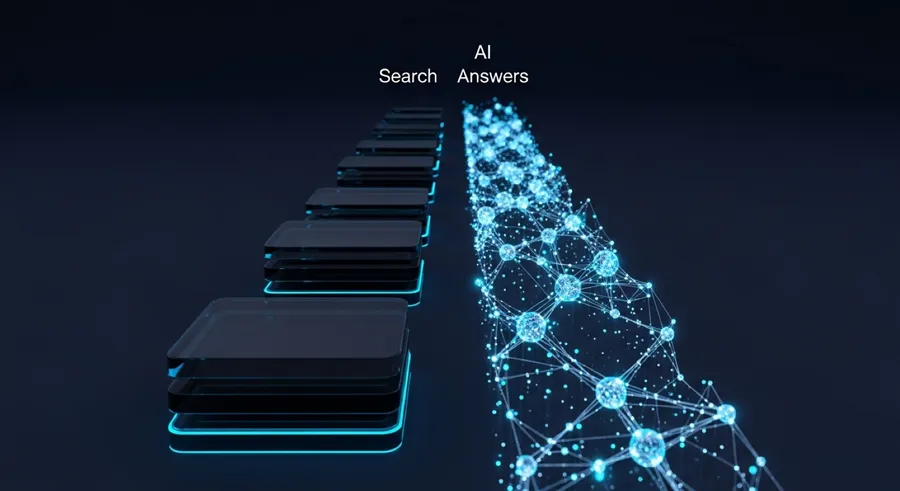
Google’s AI Overviews announcement and Search Engine Land’s tracking confirm AI-generated answers now appear above the organic results for a growing share of queries. Schema.org’s vocabulary — the structured-data layer that AI parsers depend on — has expanded faster in the last two years than in the previous decade.
This is the definitional pillar for how DEM thinks about search visibility in 2026. Start here if you’re trying to figure out where to put your budget.
Key Takeaways
- SEO optimizes your site to rank in Google’s organic results; AEO targets featured snippets and Google AI Overviews; GEO targets citation inside ChatGPT, Perplexity, and other generative engines.
- They share a foundation — clear, factual, well-structured content with schema markup helps you win in all three.
- Most businesses should still put the bulk of budget into SEO, since traditional search drives the most commercial traffic, then layer AEO and GEO on top.
- AEO and GEO matter most for awareness- and research-stage queries where buyers ask AI tools for recommendations before visiting any site.
- The right mix depends on where your buyers actually search; this is a prioritization decision, not an either/or choice between three disciplines.
What each acronym actually means
SEO: Search Engine Optimization
The original discipline. Optimizing your website so it ranks in Google’s organic results. The core components haven’t changed in 15 years, but the execution has gotten more complex:
- Technical SEO — your site must be crawlable, fast, and structurally sound. Core Web Vitals (LCP, INP, CLS), schema markup, sitemaps, canonicals.
- On-page SEO — each page targets specific queries. Title tags, meta descriptions, heading structure, word count matching the SERP average.
- Content SEO — the right topics published at the right cadence, internally linked correctly.
- Link authority — other reputable sites linking to yours. Still a top-3 ranking factor.
- Local SEO — for businesses serving a geographic area, Google Business Profile and citation consistency in addition to the above.
Who needs it: Every business with a website that wants organic traffic. No exceptions.
What it gets you: clicks on Google Search results pages — the blue links, map pack, and Google Shopping.
AEO: Answer Engine Optimization
Optimization for AI answer engines: ChatGPT, Perplexity, Google AI Overviews, Claude, Bing Copilot. These engines pull answers from the web and synthesize them — with or without a link back to your site.
AEO is about being the source AI engines cite. The tactics are different from traditional SEO:
- Schema markup that AI parsers understand (FAQPage, HowTo, Article with
datePublished,author,citation) - Citable prose — short, factual passages early in each article that can be lifted verbatim
- Structured Q&A content — questions with clear, definitive answers
- Authority signals — being cited by authoritative third parties so AI engines trust your content
- llms.txt — a curated index that tells AI crawlers what your site is and what it covers
Who needs it: Any business where customers research before buying. If someone might ask ChatGPT “what’s the best marketing agency in Mississauga” — you want to be in that answer.
What it gets you: citations in AI-generated answers, brand mentions in AI Overviews, increased brand awareness from users who never click a traditional blue link.
GEO: Generative Engine Optimization
The newest and most nuanced layer. GEO is specifically about how your brand is described in AI-generated content — not just whether you’re mentioned.
AEO gets you mentioned. GEO gets you mentioned correctly.
- Brand framing — what adjectives do AI engines use when describing your business? “Premium,” “affordable,” “local,” “enterprise”?
- Consistent brand signals — your description across your website, your GBP listing, your press coverage, and your customer reviews should all reinforce the same 2–3 attributes
- Entity recognition — building a knowledge-graph presence so AI engines treat your brand as a recognized entity, not an unknown string
- Reputation management across AI-visible surfaces — reviews, press mentions, and industry citations all feed AI models’ understanding of your brand
Who needs it: Businesses in competitive markets where AI recommendations influence buying decisions — particularly in professional services, SaaS, and premium DTC products.
What it gets you: control over the narrative when AI summarizes or recommends your business.
How the three layers stack
They’re not parallel alternatives — they compound.
SEO → AEO → GEO
Foundation → Citations → Narrative control
You can’t do AEO well without SEO in place. AI engines primarily draw from content that already ranks. If your site isn’t crawlable, properly structured, or authoritative enough to rank, AI engines won’t cite it.
You can’t do GEO well without AEO. You can’t control how AI describes you if AI doesn’t know about you at all.
The priority chain is: solid SEO → getting cited (AEO) → shaping the citation (GEO).
The Ontario business decision framework
This is where most guides get vague. Here’s the specific breakdown by business type.
| Business Type | Primary investment | Secondary | Hold for later |
|---|---|---|---|
| Local trades / home services | Local SEO + GBP | AEO (FAQ schema, Q&A content) | GEO (until established) |
| Professional services (law, accounting, medical) | SEO + AEO simultaneously | Local SEO | GEO |
| E-commerce / DTC | SEO + technical | AEO (product schema, review schema) | GEO |
| B2B SaaS | SEO + AEO | GEO | — |
| New business (< 2 years) | Local SEO first | Technical SEO | AEO once content is live |
| Established brand (10+ years) | AEO + GEO | Technical SEO maintenance | — |
Ontario-specific context
A few factors that make the Ontario market different from generic North American advice:
Competition density. Toronto is one of the most competitive SEO markets in North America. Service businesses in verticals like legal, financial, dental, and home services are competing against incumbents with a decade of domain authority. This makes the AEO layer more attractive — AI citations are a leveling force where a well-structured newer site can beat an older, authoritative site.
CASL compliance. For email-as-a-channel, Canada’s Anti-Spam Legislation affects how you can use organic content to build email lists. AEO-driven traffic that converts via newsletter or lead magnet needs CASL-compliant opt-in flows. See our B2B cold email deliverability guide for how this interacts with outbound.
Bilingual considerations. For businesses serving both Ontario and Quebec markets, French-language SEO is modestly valuable in specific verticals. Generic advice to “do bilingual content” is usually premature — confirm your Quebec traffic first.
What each layer costs and what to expect
SEO costs in Ontario
We covered this in depth in SEO Services in Toronto: The 2026 Complete Guide. The short version:
- Foundational retainer: CAD $2,000–$4,000/month — audit + on-page optimization + minimal content
- Growth retainer: CAD $4,000–$8,000/month — above plus 2–4 blog posts/month, link building, local SEO
- Enterprise: CAD $8,000–$15,000+/month — dedicated strategist, 6–10 posts, multi-location
Timeline: technical fixes compound in 2–4 months; new content rankings in 6–18 months.
AEO costs
AEO layered onto an existing SEO engagement adds roughly 10–20% to your budget. The extra work is:
- Schema audit and implementation (~$1,500–$3,000 one-time, see Schema Markup That AI Search Engines Actually Cite)
- llms.txt creation and maintenance (~$500–$1,000 one-time, see llms.txt for Local Business)
- Rewriting existing content for citable prose structure (~$200–$500/post)
Timeline: AI citation appearance is hard to benchmark because there’s no direct data source equivalent to GSC. Brand mentions in AI answers typically emerge within 3–6 months of implementation if your content authority is already established.
GEO costs
GEO is the most ambiguous to price. It’s less a distinct line item and more a lens applied to:
- Brand messaging strategy
- Review response and velocity
- PR and earned media strategy
- Content tone and positioning
Add-on to an existing engagement: roughly $500–$1,500/month as a brand signal management retainer.
A practical four-step implementation path
Most Ontario SMBs should work through these in order:
Step 1: Audit your technical foundation
Before any content or schema work, confirm your site is:
- Indexed correctly (GSC coverage report)
- Fast (Core Web Vitals in the “Good” range)
- Mobile-first (80%+ of Ontario search traffic is mobile)
- Canonical URLs consistent
See Core Web Vitals Checklist for Canadian Businesses.
Step 2: Map your content to queries
For each service or product you offer, identify:
- The head query (“Toronto marketing agency”)
- 3–5 long-tail variants (“ai marketing agency mississauga”, “google ads management toronto”)
- Question-format variants for AEO (“what does a marketing agency do”, “how much does google ads cost canada”)
Step 3: Implement schema on existing content
Before writing new content, add schema to existing high-value pages. Start with FAQPage on service pages, Article on blog posts, and LocalBusiness/ProfessionalService on your homepage. This is the fastest AEO lift from existing content.
Step 4: Build the citation authority layer
This is where AEO and GEO converge:
- Get mentioned in industry publications
- Build your GBP review velocity
- Publish your llms.txt
- Get cited by other authoritative sites in your vertical
This compounds — each citation makes future citations easier.
The honest truth about AI search in 2026
AI search is real and growing, but it hasn’t replaced Google Search for most commercial queries. Google still handles the majority of high-intent “buy now” queries. AI engines are stronger in the “research and educate” phase.
The practical implication: don’t abandon SEO for AEO. Run both. In competitive Ontario markets, businesses that execute SEO + AEO simultaneously are the ones accumulating advantage right now, because most incumbents are still SEO-only.
GEO matters most once you’re already being cited. If AI engines aren’t mentioning you yet, GEO is premature — focus on AEO first to get into the citation pool, then shape how you’re described.
For a detailed look at what AI engines are actually citing in the Ontario market and how to get your business mentioned by ChatGPT and Perplexity, see How to Get Your Business Mentioned by ChatGPT and Perplexity.
Frequently asked questions
Is AEO the same as SEO?
No. SEO optimizes for clicks on traditional search results pages. AEO optimizes to be cited in AI-generated answers, where the user often doesn’t need to click through at all. The tactics overlap (well-structured content, authoritative signals) but the specific execution — schema types, prose patterns, llms.txt — is different.
How do I know if AI engines are citing my business?
Manually: search ChatGPT and Perplexity for your business name and for the queries you want to rank for. AI-specific analytics tools are emerging but not yet standardized. Google Search Console shows AI Overview appearances in the Search Features report.
Should I optimize for Google AI Overviews or for ChatGPT?
Both, with priority on Google AI Overviews because they appear directly in Google Search results and affect click-through on your existing organic rankings. ChatGPT matters more for research-phase queries; Google AI Overviews matter more for commercial queries.
Does GEO require a different website or different content?
No. GEO is mostly about consistency and signal reinforcement across existing surfaces — your website, GBP listing, press, reviews. You don’t need a separate “GEO website.” You need your brand story to be consistent across every surface AI crawlers can access.
Where this fits in our work
This is the conceptual pillar for our entire AI search cluster. The implementation posts sit underneath it:
- Schema implementation: Schema Markup That AI Search Engines Actually Cite
- llms.txt: llms.txt for Local Business
- Getting cited: How to Get Your Business Mentioned by ChatGPT and Perplexity
- Toronto-specific SEO: SEO Services in Toronto: The 2026 Complete Guide
- Core Web Vitals: Core Web Vitals Checklist for Canadian Businesses
- Full reference: our complete AEO & GEO guide
If you want us to build the full SEO + AEO stack for your Ontario business, our AI SEO service, SEO services, and Google Ads engagements cover all three layers — technical foundation, on-page and content SEO, schema and llms.txt for AI citation, and brand monitoring. Start with a free discovery call.
Sources
- Google — Generative AI in Search announcement — accessed 2026-05-22
- Search Engine Land — AI Overviews and SGE coverage — accessed 2026-05-22
- Schema.org — main vocabulary — accessed 2026-05-22
- Google Search Central — Structured data documentation — accessed 2026-05-22
- Ahrefs — How long does it take to rank — accessed 2026-05-22