
· By Salman Habib Chaudhry · SEO · 9 min read
SEO Services in Toronto: The 2026 Complete Guide
What SEO services cost and deliver in Toronto in 2026 — core components, deliverables worth paying for, agency-selection questions that matter, and honest timelines to results.
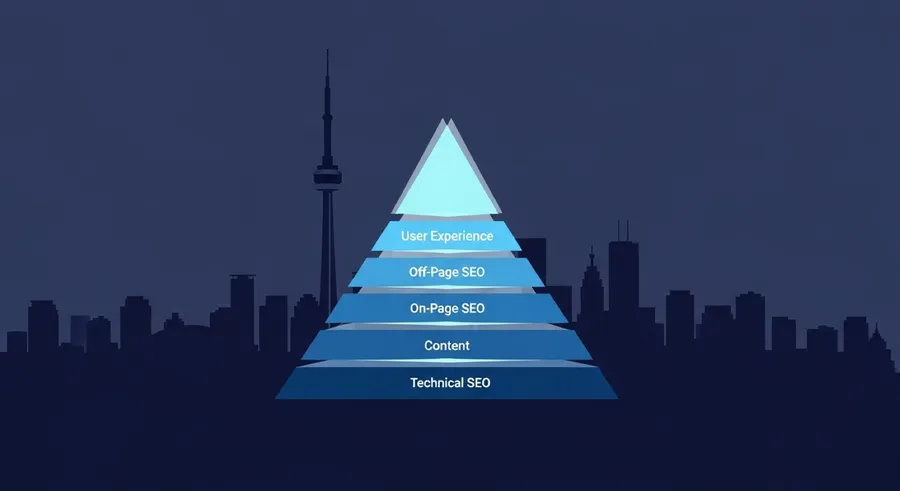
SEO services in Toronto run roughly CAD $2,000–$15,000/month depending on scope, and a real engagement covers four layers: technical, on-page, content, and AI search. That’s the short answer. The rest of this guide explains what each layer includes, what’s worth paying for, how to vet an agency, and how long results actually take.
Toronto is one of the most competitive SEO markets in North America. Law firms, financial services, dentists, home services, SaaS — every vertical has established incumbents, aggressive newcomers, and thousands of pages competing for the same queries. Winning organic visibility here takes more than a checklist; it takes a deliberate multi-channel strategy executed consistently over time. If you’re evaluating SEO services for your Toronto business, start here.
Key Takeaways
- Toronto SEO retainers run roughly CAD $2,000–$4,000/month for foundational work, $4,000–$8,000 for a content-and-links growth engagement, and $8,000–$15,000 for enterprise scale.
- A real Toronto engagement covers four layers — technical, on-page, content, and AI search (GEO/AEO). Single-layer agencies rarely move competitive markets.
- Realistic timelines: technical fixes show in 2–4 months, on-page in 4–8 weeks, content-driven traffic in 6–12 months, and net-new competitive pages in 6–18 months.
- When hiring, ask to see real GSC/GA4 data from your market segment, and walk away from guaranteed-ranking promises or 12-month lock-ins without exit clauses.
- Businesses serving the wider GTA need uniquely written location pages for suburbs like Mississauga, Brampton, and Oakville — not city-name-swapped duplicates.
The four layers of modern SEO
SEO in 2026 is no longer one thing. A real engagement covers four overlapping layers:
- Technical SEO — your site is crawlable, fast, and parseable.
- On-page SEO — each page is optimized for specific queries.
- Content SEO — the right topics, published at the right cadence, linked correctly.
- AI search (GEO/AEO) — discoverable and citable by ChatGPT, Perplexity, Google AI Overviews.
Agencies specializing in only one of these exist, but they rarely move the needle for competitive Toronto markets. You need coverage across all four.
Layer 1: Technical SEO
What a proper technical engagement includes:
- Site audit with Screaming Frog or equivalent. Every indexable page audited for title, meta description, canonical, heading structure, word count, internal links in/out.
- Core Web Vitals — real field data from CrUX, not just lab scores, per Google’s Core Web Vitals documentation. See our CWV checklist.
- Index coverage — GSC-verified; every page is either indexed or intentionally excluded.
- Structured data — Schema.org markup for Organization, LocalBusiness, Article, FAQPage, BreadcrumbList, etc., aligned with Google’s structured data guidelines. See Schema Markup That AI Search Engines Actually Cite.
- XML sitemaps and robots.txt configured correctly.
- Redirects — no chains, no 404s, no wrong canonicals.
- Security headers — HSTS, CSP, nosniff, frame-options. Minor ranking signal and major trust signal.
Typical Toronto pricing for a one-off technical audit + fix: CAD $4,000 – $10,000. Ongoing technical maintenance is usually bundled into a monthly retainer.
Layer 2: On-page SEO
For each page you want to rank:
- Primary keyword research — head term + 3-5 long-tail variations.
- Title tag — primary keyword, under 60 characters, compelling enough for CTR.
- Meta description — under 160 characters, benefit-led, includes primary keyword.
- H1 that matches intent, plus logical H2/H3 structure.
- Word count that matches the SERP. If top-10 results average 2,500 words, your page needs to be competitive.
- Internal links to the page from at least 3 other relevant pages on your site.
- Images — alt text, compressed, aspect ratios that prevent CLS.
- Page-level schema (Article, Service, FAQPage as appropriate).
Toronto competition means on-page work needs to be done well for every page that matters. There’s no “good enough” in a market where your top 10 competitors all have full-stack SEO teams.
Layer 3: Content SEO
Content is the leg where Toronto SEO budgets actually get consumed. Production cadence varies by business type:
| Business type | Recommended cadence | Typical monthly cost (CAD) |
|---|---|---|
| Local service business | 2–4 blog posts/month | $1,500 – $3,500 |
| Professional services | 3–6 blog posts/month | $2,500 – $6,000 |
| SaaS / tech | 4–10 blog posts/month | $4,000 – $12,000 |
| E-commerce | 2–6 posts + product page SEO | $2,500 – $8,000 |
What “a blog post” includes when done well:
- 1,200–2,500 words (by query intent).
- Original research, quotes, or experience — not AI regurgitation.
- Proper schema (Article, author, datePublished, dateModified).
- 3–5 internal links to cluster siblings and pillars.
- 1+ external citation to authoritative source.
- Image + alt text.
- On-page optimization per layer 2.
Why Toronto content costs what it does: good writers who actually understand the markets (law, finance, medical, SaaS) charge CAD $300–$1,000 per post. AI-drafted content with light editing gets caught by Google quality updates quickly. Cheap content is usually a false economy.
Layer 4: AI Search (GEO/AEO)
The newest layer and the fastest-evolving. See SEO vs AEO vs GEO: What Your Business Actually Needs for the conceptual framework.
What the AI-search layer looks like tactically:
- llms.txt published and kept current. See llms.txt for Local Business.
- Structured data prioritizing AI-cited types — FAQPage, HowTo, DefinedTermSet, Article with citation field.
- Citable prose patterns — short, factual passages early in each article. The kind of writing ChatGPT can lift verbatim.
- Brand mentions across authoritative sources — press, podcasts, industry publications. See How to Get Your Business Mentioned by ChatGPT and Perplexity.
- Glossary or reference content — DEM’s glossary is a worked example.
In Toronto’s competitive SERPs, AI search is often where smaller businesses can leapfrog incumbents. Incumbents are slow to adopt; newer entrants who invest here early gain outsized visibility in AI summaries. A practical way to track progress: keep a short list of the questions your buyers would ask an AI (“best [your service] in Toronto,” “how to choose a [your service] firm in the GTA”) and run them monthly through ChatGPT, Perplexity, and Google AI Overviews to see whether you’re being cited and who’s beating you. Our guide on how to rank in ChatGPT goes deeper on the tactics.
What SEO services actually cost in Toronto (2026)
We covered pricing in depth in Marketing Agency Cost in Toronto 2026. For SEO specifically:
- Foundational SEO retainer (CAD $2,000 – $4,000/month): Technical audit + fix, basic on-page optimization of 8–12 pages, minimal content, monthly reporting. Fine for small local businesses.
- Growth SEO retainer (CAD $4,000 – $8,000/month): Above plus 2–4 blog posts, content strategy, link building, local SEO layer. Typical sweet spot for Toronto SMBs.
- Enterprise SEO retainer (CAD $8,000 – $15,000/month+): Dedicated strategist, 6–10 posts, multi-site or international SEO, technical SEO at scale.
Realistic timelines
The single most common source of SEO-engagement disappointment is unrealistic timelines.
- Technical fixes: 1–2 months for full implementation. Visible impact within 2–4 months.
- On-page optimization: Existing pages tend to see ranking shifts within 4–8 weeks.
- Content-driven growth: 6–12 months for a new content strategy to compound.
- Net-new pages ranking for competitive queries: 6–18 months depending on competition.
Any Toronto agency promising top-3 rankings for competitive terms in 60 days is either lying or going to burn through unsustainable tactics. Good SEO is slow and compounds.
How to evaluate a Toronto SEO agency
Seven questions to ask every agency you’re considering:
- Can you show me three clients in my market segment, and what their before/after metrics look like? Not testimonials — actual GA4 or GSC data with real numbers. If they can’t share specifics (confidentiality is fine) but can at least speak to patterns, keep listening.
- How do you measure success? Rankings alone is the wrong answer. Organic traffic, conversion volume, and pipeline attribution are what matter.
- What’s your content production process? If it’s “we use AI to draft and ship,” walk away. The answer should involve real writers, editing standards, and subject-matter review.
- How do you approach technical SEO? They should mention Screaming Frog, GSC, Lighthouse/CrUX, and structured data by name.
- What’s your link-building approach? Good answers: digital PR, HARO-style outreach, earned citations from real research, guest posts on legitimate sites. Bad answers: PBNs, paid directories, link farms.
- What does month 1, month 3, and month 6 look like? If they can’t give you a specific phased plan, they don’t have one — for reference, here’s how we work through onboarding, audit, and the first 90 days.
- What’s your exit clause? Good agencies offer month-to-month or 3-month contracts with performance exits. 12-month lock-ins without performance clauses are a flag.
Toronto-specific SEO considerations
- Location pages matter. Toronto businesses serving the wider GTA should have neighbourhood-level and suburb-level landing pages (Downtown, North York, Scarborough, Etobicoke, Mississauga, Oakville, Brampton, Markham). Our own locations directory is a worked example.
- Compete with strong incumbents. Every Toronto vertical has 5–10 established websites with domain authority built over 10+ years. Ranking requires patience and quality that compounds.
- French-language SEO. If you serve Quebec-adjacent markets, consider bilingual content. The SEO gains are modest for most Toronto businesses but meaningful for some verticals.
- Ontario-specific regulatory content. For law, finance, medical, and accounting firms, province-specific content (Ontario tax, Ontario family law, Ontario real estate) outperforms generic Canadian content.
Where this sits in our work
This is the Toronto companion to our Toronto service-area page, and the pillar-scale post for the Local SEO & Ontario cluster. It references every other post in this cluster — the Local SEO checklist, GBP optimization, NAP consistency, and getting reviews — because winning in Toronto requires all of them running in parallel.
If you want us to run SEO for your Toronto business, that’s the core of what we do: foundational technical, on-page optimization across your key pages, 2–6 blog posts per month, AI-search layer, local SEO, and monthly reporting. Every engagement starts with a free discovery call where we audit your current state and show you where a DEM engagement would move the needle. Our SEO services page is the canonical scope; the AI SEO service covers the GEO/AEO layer; the Local SEO service is the companion for map-pack-heavy businesses. For consultant-vs-agency questions read the Toronto SEO consultant hiring guide, and for the agency-pricing context see Marketing agency cost in Toronto 2026. The AI-search conceptual reads are LLMO explained and what is AEO. Still have questions before reaching out? Our FAQ page answers the most common ones on pricing, timelines, and what’s included.
Sources
- Google — Core Web Vitals (web.dev) — accessed May 2026
- Google Search Central — Structured data introduction — accessed May 2026
- Google Search Central — SEO Starter Guide — accessed May 2026
- Search Engine Land — SEO library — accessed May 2026
- Search Engine Journal — SEO category — accessed May 2026