· By Salman Habib Chaudhry · SEO · 5 min read
What Is AEO? How Answer Engine Optimization Works in 2026
Answer Engine Optimization in plain English — how AEO differs from SEO and GEO, plus 5 strategies to earn citations in ChatGPT, Perplexity, and Google AI Overviews.

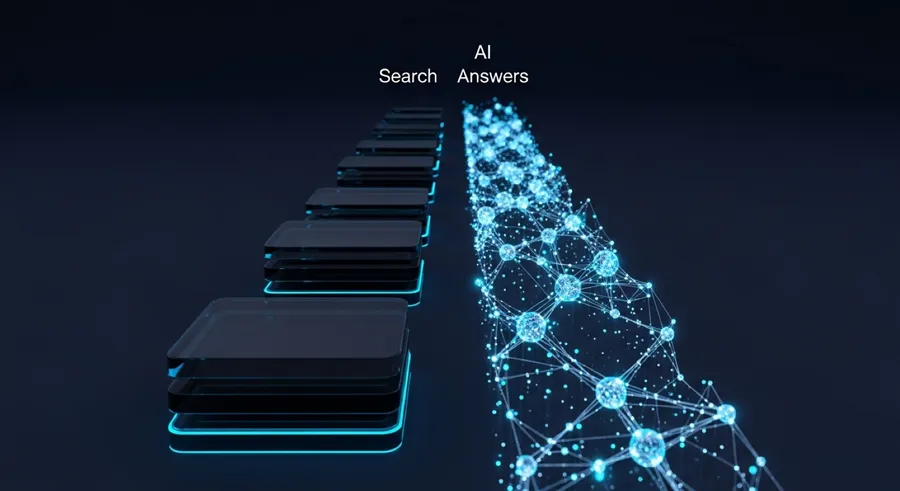
Search is splitting into two channels. Traditional search engines like Google still process billions of queries. But AI answer engines — ChatGPT, Perplexity, Google AI Overviews, Microsoft Copilot — now answer questions directly without requiring a click. Pew Research and industry studies through 2025 show buyers increasingly start their research inside chat interfaces rather than the Google SERP. Our AI Search & GEO statistics for 2026 collect 30+ cited data points on exactly how far this shift has gone — AI Overviews reach, ChatGPT and Perplexity usage, and the zero-click impact on traffic.
This shift has created a new discipline: Answer Engine Optimization (AEO).
Key Takeaways
- Answer Engine Optimization (AEO) is the practice of getting your business cited as a source inside AI-generated answers from ChatGPT, Perplexity, Google AI Overviews, and Copilot.
- Where SEO targets keyword rankings and clicks, AEO targets questions and entities and earns citations and brand authority.
- AEO rewards structured, factual, citable content — clear question-and-answer formats, defined entities, and schema markup the parsers can read.
- AEO and SEO are complementary, not competing: the same authoritative content that ranks in Google also tends to get cited by answer engines.
- Buyers increasingly start research inside chat interfaces, so being absent from AI answers means being invisible at the awareness stage.
AEO vs. SEO — What’s the Difference?
Traditional SEO is about ranking pages in Google’s organic results. AEO is about getting your business cited as a source in AI-generated answers.
- SEO targets SERPs. AEO targets AI answer panels.
- SEO optimizes for keywords. AEO optimizes for questions and entities.
- SEO drives clicks. AEO drives citations and brand authority.
- SEO rewards link authority. AEO rewards structured, factual, citable content.
How AI Answer Engines Choose Sources
When an AI engine answers a question, it generally does so in two passes. First it retrieves a shortlist of candidate sources — through live web search (ChatGPT browsing, Perplexity, Google AI Overviews) or from what it already knows about your brand as an entity. Then it synthesizes an answer and decides which of those sources to credit. To win, you have to clear both bars: be retrievable and be the cleanest, most quotable source on the shortlist.
That means three things matter more than they did in pure blue-link SEO:
- Passage-level clarity. Engines lift specific sentences, not whole pages. A page that states “Mississauga local SEO typically takes 60–90 days to show Map Pack movement” in one clean sentence gets cited; a page that buries the same point in a meandering paragraph does not.
- Entity consistency. The engine has to be confident about who you are. Matching name, location, and service language across your site, Google Business Profile, and third-party directories raises the odds it associates a topic with your brand.
- Corroboration. AI engines weight claims that appear in more than one trustworthy place. A figure you publish is stronger if it’s echoed by an independent source — which is why original data plus outside mentions beats either alone.
Your content needs to be structured, factual, and authoritative enough to clear both the retrieval pass and the synthesis pass.
5 Strategies to Optimize for AEO
1. Structure Content Around Questions
Use clear H2/H3 headings that mirror natural language questions. Provide concise answers in the first 1-2 sentences, followed by supporting detail.
2. Use Structured Data (Schema Markup)
FAQPage, HowTo, Article, and Organization schema help AI engines understand and cite your content correctly. See Google’s structured data guide for the canonical JSON-LD spec, and our schema-for-AI deep dive for the types that earn citations.
3. Build Entity Authority
Publish expert content, get quoted in publications, and maintain consistent branding across your digital presence.
4. Publish Original Research and Data
AI engines favour original statistics, benchmarks, and case studies. Specific data gets cited; generic advice gets ignored.
5. Maintain Consistent NAP and Brand Mentions
For local businesses, consistent Name-Address-Phone mentions reinforce your entity in knowledge graphs. This is where local SEO and AEO overlap.
What About GEO?
Generative Engine Optimization (GEO) specifically targets how your content appears in generative AI outputs. Where AEO focuses on getting cited, GEO goes further: optimizing so AI engines present your information favourably and accurately. In practice the two have all but converged — by 2026 most teams use the terms interchangeably and run a single workflow that covers both featured-snippet-style answers and full generative responses. If you want the longer treatment, see LLMO explained and how to optimize for AI search.
Does AEO Replace SEO?
No. AEO complements SEO. In 2026, winning businesses do both: SEO captures Google traffic, AEO captures AI citations.
Our dedicated answer engine optimization service and broader AI SEO service integrate both. Book a free discovery call and we’ll show you where you stand.
Related reading:
- LLMO Explained: Large Language Model Optimization
- How to Optimize Your Site for AI Search
- The Future of SEO: AI Search & GEO
- Perplexity SEO: How to Get Cited
- The complete AEO & GEO guide
Sources
- Google Blog — Generative AI in Search (AI Overviews) — Accessed 2026-05-22
- Google Search Central — Structured data introduction — Accessed 2026-05-22
- Pew Research — Trust in news media (2025) — Accessed 2026-05-22